
What are the Substructure Works for Indoor Artificial Turf Pitch Construction?
What are the Iron Pipe Works?
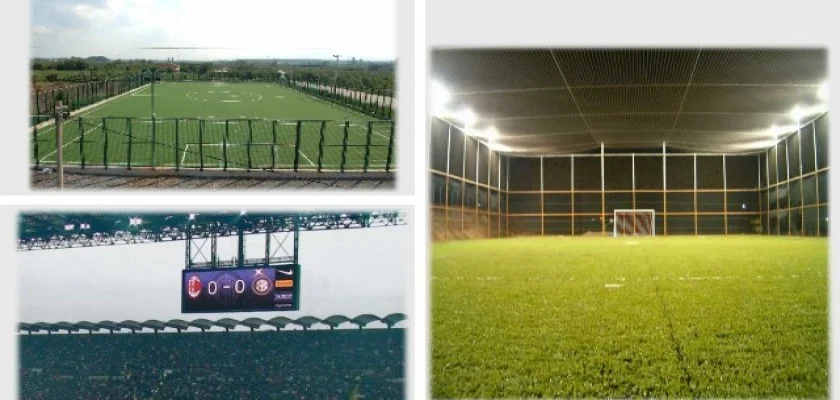
Excavation is carried out at the appropriate width and depth determined for the construction of the pitch, and the excavated soil is removed from the site. Wooden formwork, 50cm wide and 60cm high, is attached to the short sides of the pitch, and formwork, 70cm wide and 60cm high, is attached to the long sides. Binding is done using eight 14mm reinforcing bars with 8mm stirrups at 20cm intervals. Plates with 18 gijons and nuts, spaced 3m apart, are placed on the columns and beams where the trusses will be located and fixed. Concrete is poured into the surrounding formwork to form the reinforced concrete structure. The gaps in the beams are filled with crushed stone, also known as gravel. After the ground is paved with gravel, a roller is used for leveling. The iron pipes and connections used in the construction of the artificial turf pitch are divided into sections such as flanges, supports and trusses, goalpost uprights, tarpaulin and wire connections, cross braces between trusses, wind braces, and roof purlins. The 4-meter high vertical pipes required for the construction of the indoor artificial turf pitch are assembled by welding them onto plates with 18 gijons and nuts. 10mm steel plates are mounted on the vertical columns. Trusses are formed by welding the top and bottom pipes parallel to each other. Purlins made of pipes are then mounted on the formed trusses.
How are the Construction Closing Works Done?
During the construction of the indoor artificial turf pitch, after the main frame is completed, attention should be paid to the properties of the tarpaulin used to cover the pitch. The tarpaulin, made using polyester high-strength technical industrial yarn, is of high quality. This product is resistant to all kinds of heat and cold, from -30 to 70 degrees, and is highly resistant to the UV rays of the sun. The tarpaulin, which weighs 650 grams per square meter, is made from 1100 Dtexs fabric. After vertical pipes are placed at the goal ends, the main frame is formed. Wind braces and cross pipes are placed between the trusses at the specified dimensions. Tarpaulin and wire connection pipes are then welded on top. Special pipes with dimensions of 48-3mm and 89-3mm are used for goalposts and for creating a hinged door at the desired location. The constructed structure is painted with a special synthetic resin anti-rust paint.





